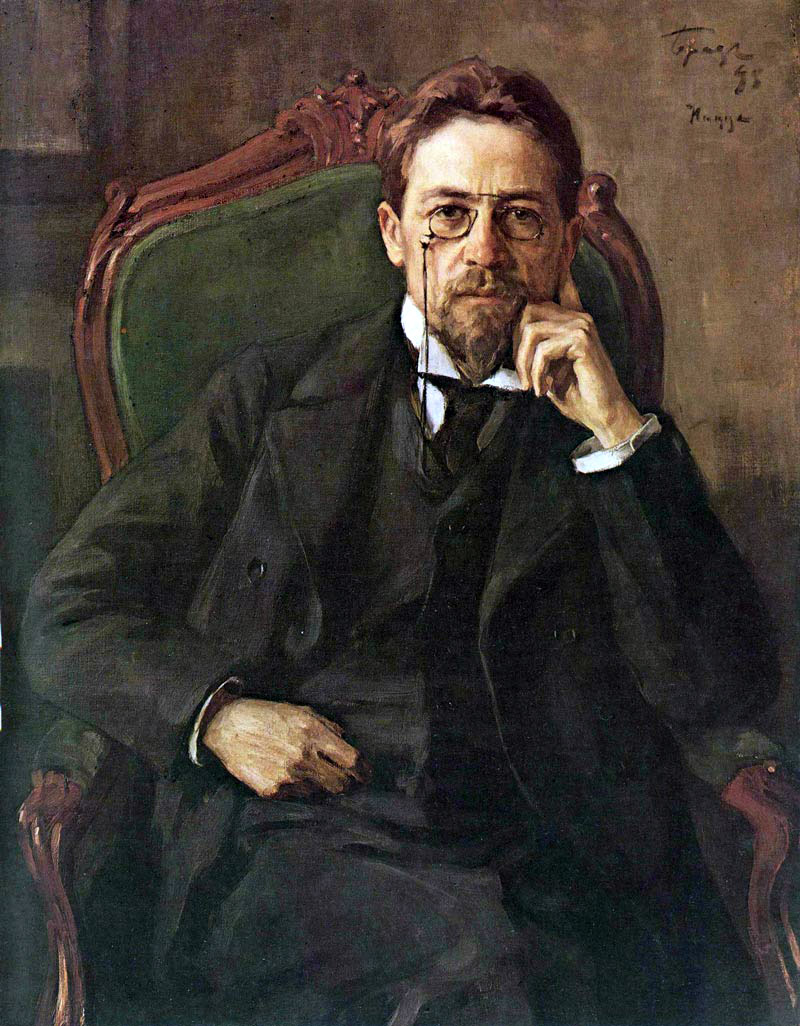
Anton Chekhov
His first story appeared in a Moscow paper in 1880, and after some difficulty he secured a position connected with several of the smaller periodicals, for which, during his student years, he poured forth a succession of short stories and sketches of Russian life.
His audience demanded laughter above all things, and, with his deep sense of the ridiculous, Chekhov obliged. His stories, though often based on themes profoundly tragic, are penetrated by the light and subtle satire that has won him his reputation as a great humorist.
A passionate enemy of all lies and oppression, he already foreshadows in these early writings the protest against conventions and rules.
In 1884 he took his degree as doctor of medicine, and decided to practice, although his writing had by now taken on a professional character. He always gave his calling a high place, and the doctors in his works are drawn with affection and understanding.
Chekhov fully realized later the influence which his profession had exercised on his literary work, and he was able to write: “Only a doctor can know what value my knowledge of science has been to me,” and “It seems to me that as a doctor I have described the sicknesses of the soul correctly.”
His first collection of stories appeared in 1887, another one in the same year had immediate success, and both went through many editions.
Weary and with an obstinate cough, he went south in 1888, “One would gladly sell one’s soul for the pleasure of seeing the warm evening sky, and the streams and pools reflecting the darkly mournful sunset.” He described visits to his country neighbours and long drives during which, “we ate every half hour, and laughed to the verge of colic.”
His health, however, did not improve. In 1889 he began to have attacks of heart trouble.
The burden of his growing fame was beginning to be very irksome to him, and he wrote wearily at this time that he longed to be in the country, fishing in the lake, or lying in the hay.
Chekhov’s delicate and elusive descriptive power was best suited to his strange little tragic-comedies of Russian life, his “Tedious Tales,” as he called them.
In 1890 Chekhov's health failed, and the consumption, with which he had long been threatened, finally declared itself. His illness exiled him to the Crimea, and he spent his last ten years there. His four important plays were written during this period of his life.
Chekhov died suddenly in a little village, whither he had gone in the hope of recovering his lost health.
Chekhov, with an art peculiar to himself, in scattered scenes, in haphazard glimpses into the lives of his characters, in seemingly trivial conversations, succeeded in showing the Russia of his day.


No comments:
Post a Comment