Sadly the real #RosieTheRiveter, or Niomi Parker Fraley died a few days ago, aged 96.
Resistance and change often begin in #art, and then in our #He{ART}.
#IdeasCanChangeTheWorld!
Philip Roth’s The Plot Against America (2004)
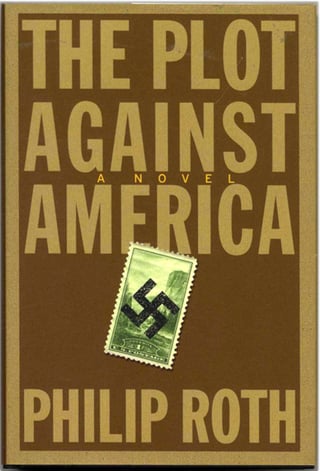 More than 40 years after Dick published The Man in the High Castle, Philip Roth imagined a mid-twentieth-century world in which Franklin Delano Roosevelt lost the 1940 election to Charles Lindbergh, an anti-Semitic Nazi sympathizer. That novel, The Plot Against America (2004), brought renewed interest in the World War II era and the “what ifs” of Nazism and totalitarianism.
Unlike in Dick’s novel, however, the Allies still win the war. However, the text serves as a reminder that the gross injustices of World War II, largely the anti-Semitic murderous ideology of the Third Reich, are not limited to one particular historical moment. Discussing the continued significance of the novel, Richard Brody explains that The Plot Against America is ultimately about “how it can happen here; about how, if it were to happen here, American Jews and, for that matter, many other courageous Americans would rise up, organize, and resist; and about how altogether American resistance against an altogether American abuse of power might nonetheless not suffice.”
Through different literary modes, Dick and Roth are asking similar questions: what if World War II had turned out differently? What if American involvement in World War II had looked different? In 2015, Amazon released a television series entitled The Man in the High Castle, adapted largely from Dick’s novel but picking up on threads from Roth’s novel, as well.
Ultimately, the questions with which we are left concern the extent to which we are willing to endure violence against the so-called Other, and whether our resistance efforts in the face of tyranny can ever be sufficient. Or, worse yet, what if we’re complacent? Whether we’re building a history books collection, reading one of the novels we mentioned, watching the television adaptation, or perhaps putting together a WWII book collection, we’re reminded that another moment of tyranny could be lurking.
"Words are, of course, the most powerful drug used by mankind."
By
Brian Hoey.
Dec 30, 2017. 9:00 AM.
Topics:
Legendary Authors,
Nobel Prize Winners
In 1942, as ever, George Orwell
was bemused. He had spent the early decades of the century wondering
how so many Britons could hold Rudyard Kipling’s “If—” (1896) so dearly
without realizing that “(f)ew people who have criticized England from
the inside have said bitterer things about her” than its author. In a
way, Orwell’s outrage gets right to the heart of the questions begged by
the man who remains the youngest (and first) English-language writer to
win the Nobel Prize in Literature. Of the writer dubbed a genius by Henry James and a unique master of verse by T. S. Eliot,
are we as 21st century readers meant to see a sententious
imperial-minded jingoist, or a sharp social critic and astute wordsmith?
Very probably, the answer is a lot of both—which may account for why
works like The Jungle Book (1894), The Second Jungle Book (1895), The Seven Seas (1896), and, yes, “If—” remain widely read and widely loved. Here are ten of the most pointed and enduring Rudyard Kipling quotes.
1. "Words are, of course, the most powerful drug used by mankind." —Rudyard Kipling
2. "Everyone is more or less mad on one point." —Rudyard Kipling, Plain Tales from the Hills (1888)
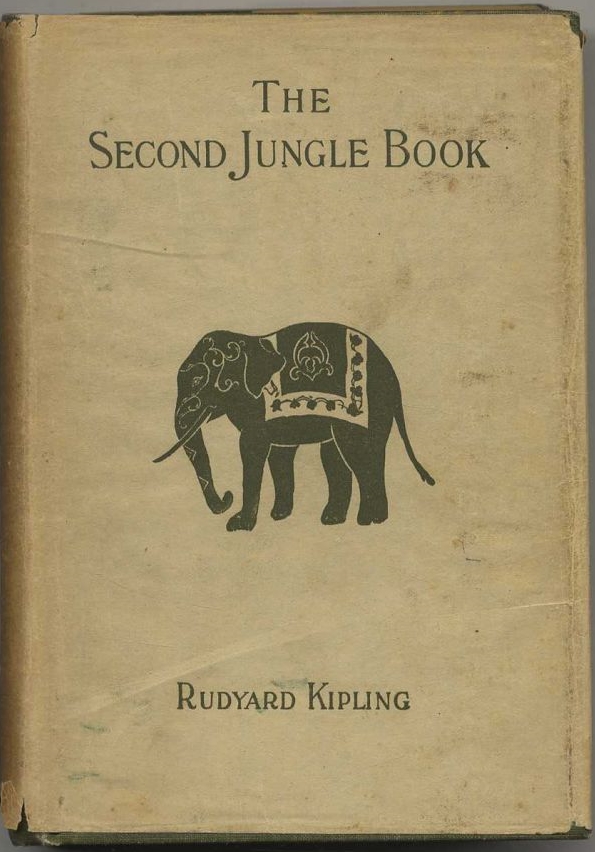
3. "As the creeper that girdles the tree trunk, the Law runneth forward and back;/For the strength of the Pack is the Wolf, and the strength of the Wolf is the Pack." —Rudyard Kipling, The Second Jungle Book (1895)
4. "An ounce of demonstration is worth a ton of theory." —Rudyard Kipling, From Sea to Sea (1889)
5. "A people always ends by resembling its shadow." —Rudyard Kipling
6. "If you can dream—and not make dreams your master;/ If you can think—and not make thoughts your aim;/ If you can meet with Triumph and Disaster/And treat those two impostors just the same," —Rudyard Kipling, "If—" (1910)
7. "If you can force your heart and nerve and sinew/ To serve your turn long after they are gone,/And so hold on when there is nothing in y
 ou/Except the will which says to them: 'Hold on!'" —Rudyard Kipling, "If—"
8. "I keep six honest serving-men:/(They taught me all I knew)/Their names are What and Where and When/And How and Why and Who." —Rudyard Kipling, Just So Stories (1902)
9. "He wrapped himself in quotations - as a beggar would enfold himself in the purple of Emperors." —Rudyard Kipling, The Finest Story in the World (1891)
10. "I have written the tale of our life/For a sheltered people's mirth,/In jesting guise—but ye are wise,/And ye know what the jest is worth." —Rudyard Kipling, Departmental Ditties (1886)


No comments:
Post a Comment