This flower is everywhere in our neighborhood and is edible (coffee extender).
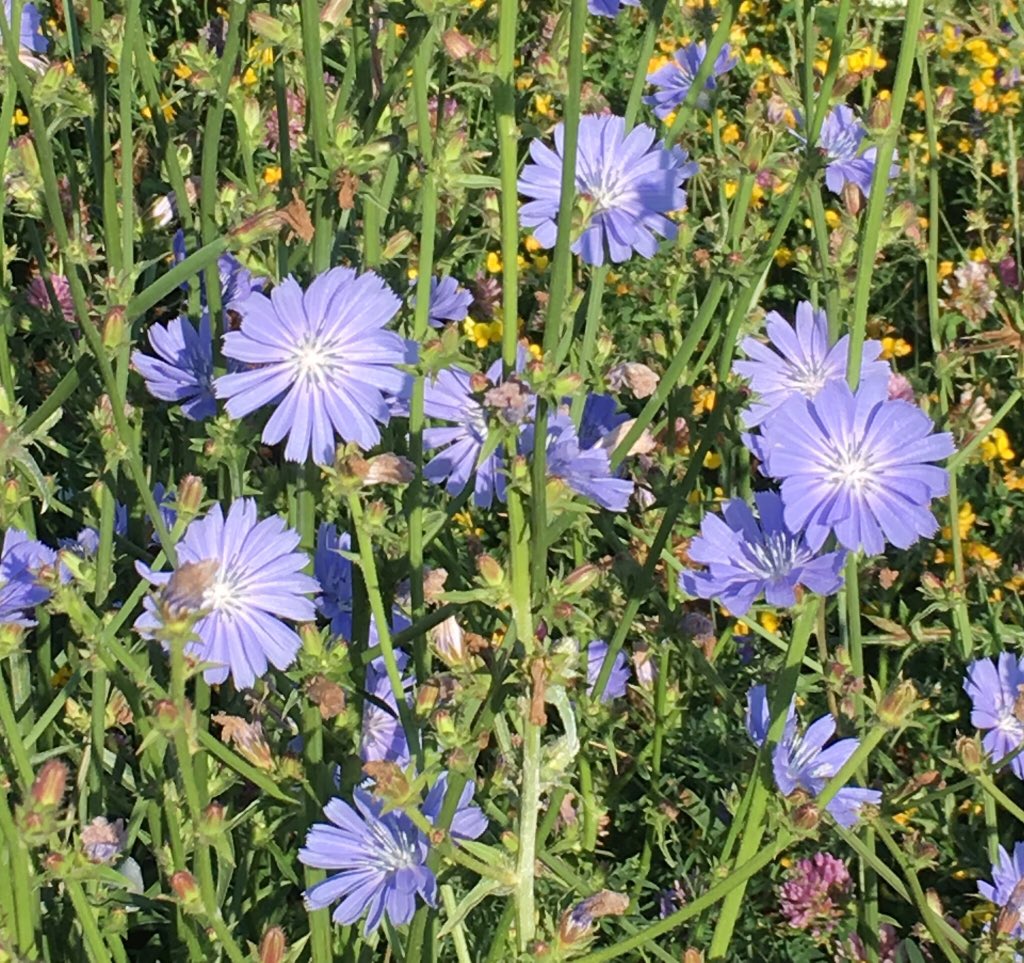

Chicory (Cichorium intybus) seen on my walk to work this morning. Lovely blue colour.
Common chicory

| |||||
| 1885 illustration | |||||

| |||||
Scientific classification 
| |||||
|---|---|---|---|---|---|
| Kingdom: | Plantae | ||||
| Clade: | Angiosperms | ||||
| Clade: | Eudicots | ||||
| Clade: | Asterids | ||||
| Order: | Asterales | ||||
| Family: | Asteraceae | ||||
| Genus: | Cichorium | ||||
| Species: | C. intybus | ||||
Many varieties are cultivated for salad leaves, chicons (blanched buds), or roots (var. sativum), which are baked, ground, and used as a coffee substitute and food additive. In the 21st century, inulin, an extract from chicory root, has been used in food manufacturing as a sweetener and source of dietary fiber.
Chicory is grown as a forage crop for livestock. It lives as a wild plant on roadsides in its native Europe, and is now common in North America, China, and Australia, where it has become widely naturalized.
"Chicory" is also the common name in the United States for curly endive
Common
chicory, Cichorium intybus, is a somewhat woody, perennial herbaceous
plant of the dandelion family Asteraceae, usually with bright blue
flowers, rarely white or pink.


No comments:
Post a Comment